Start with one large architectural plan like this one.
Fold it in half horizontally.
Fold it in half horizontally a second time.
Open it up completely so all three creases show.
Cut along the creases so you have four strips of paper.
Use colorful duct tape or blue painter's tape to tape all four pieces of paper together end to end. You don't have to overlap the paper when you tape each piece together.
You will end up with one very long piece of paper.
Place your strip of paper printed side up. Fold back one end to make a square and crease the paper. Fold the other way next. You'll be making an alternating or accordion fold out of the entire strip of paper.
You may have a bit of extra paper that you can cut off with scissors. Don't worry if our pages are not even. You will fix this once you're done making your journal.
The next step is to tape the left side of your journal together with one or two pieces of duct tape or blue painter's tape. You journal should then open like this.
Finally, use a pair of scissors or the paper cutter, with teacher's help, to trim the extra tape and make the top and bottom more even. DO NOT TRIM THE SIDES. Then apply a piece of folded card stock to the front cover to give your journal a strong, colorful surface to create your cover art.
You may now decorate your front cover. Include your full name and the word "History" on your cover. Select one of the people listed here to feature on your cover. Look up some information about the person you selected along with some images. Create a cover about the person you chose including words and original artwork. DueThursday.
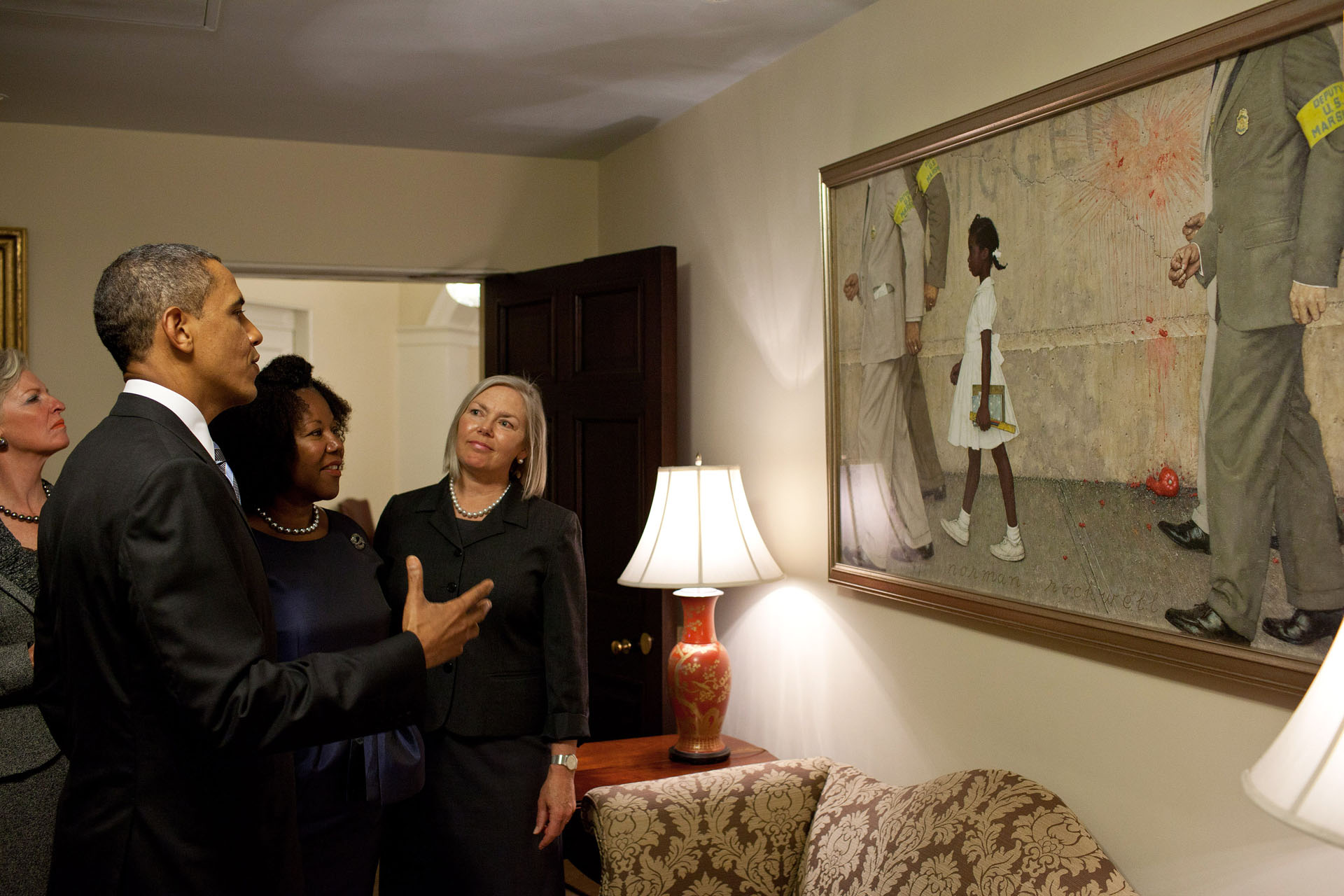
For this activity you will look at several images, photographs and paintings. Because Ruby Bridges faced very extreme racism in her childhood some of the images may be upsetting and may contain language that is not normally allowed on this website or in class.
Please remember to be respectful when viewing them.
Here are a few samples of the "Witness in a Box" projects from our 7th grade students. Scroll down for more details about how the boxes were made or click here. These samples come from all of the 7th grade classes.
How is where we come from important to who we are?
Much of Brown Girl Dreaming deals with the theme of how where we come from affects who we become. This includes time as well as place. The time period a child was born into, what was going on in history during your early life, affects the adult she grows up to become.
For this project you will research a person or event from the time period covered in Brown Girl Dreaming, the Civil Rights Era in American history. You will then create a "Cornell Box" that illustrates your research as a visual metaphor. You will also write up a short $1.50 account of your research. Both your research and your Cornell Box will be presented to the class as a speech. You will then write a first person poem based on your box which you might choose to present at the class poetry slam.
You must select a topic/person from the list below. As part of your research, you will use the audio/visual link attached to your topic, photographs of the event/person you can find online and one article that you locate on your own.
Here are the people/events you can choose from. Be sure to let the teacher know what your selection is. No more than two people may do the same topic.
Each person is linked to an audio/visual program about them. You are required to use this program as part of your research. Listen to it once, then listen again while taking notes about it.
Find a second article about that person or event and a few photographs to help you understand the importance of your selection. You may print out a few photographs (1 to 3) to use as part of your Cornell Box. However, you may not use a picture of the actual person or event. You Cornell Box must be a metaphor, not an exact representation.
You will use your research to create a box about your selection in class later this week.
For this extension activity you will research one of the elements S.E. Hinton incorporated into her novel, The Outsiders.
Your project must include visuals and multiple paragraphs. The number of paragraphs is dependent on the topic you choose.
You may present your findings in any format, such as an essay, brochure, presentation, model, or display. You are only limited by your own creativity.
Be sure to discuss and explore in-depth how the element you chose to research is featured in the novel. Include an introduction, body paragraphs and an conclusion.
Choose a research topic from the following:
Tuff cars of the mid-60's: Corvairs, Mustangs, T-Birds and Corvettes
Greaser icons: James Dean in Rebel Without a Cause and Marlon Brando in The Wild One.
Music: Elvis, The Beatles and Hank Williams
Rodeo Events
Books: Great Expectations by Charles Dickens: Gone With the Wind by Margaret Mitchell; The Call of the Wild by Jack London.
Drive-in culture; movie genres and representative examples from the golden age of the drive-in, the late 50's to the mid-60's.
Robert Frost and his poetry
You project will be graded on the visible effort shown in your visual and on the overall quality of your essay. All other elements of your project, depending on the project you select, will be counted towards your overall grade.
The Journey to the West was a novel published in China in 1592 (16th Century.) It tells the story of a Buddhist monk named Xuanzang who traveled from central China in the mid 7th century, across the Himilayas to India where he studied Buddhism. He wanted to learn the ancient Buddhist texts and bring them all back to China where Buddhism was still a new idea.
If Zuanzang is the hero of his journey, then his three companions are his allies: Sun Wukong (the Monkey King), Zhu Bajie (Pigsy) and Sha Wujing (A strong man called Sandy also known as the Water Buffalo.) The three companions were probably not based on real people. They are considered folklore and have been very popular in China. Each of them goes on the journey to atone for their sinful lives by helping Xuanzang.
You can read about Monkey by following the two links below.
Your assignment:
Create a book about Buddhism in China. Your book will include information about The Journey to the West and about Buddhism in China. Your book will take the form of a Tibetan prayer book like the ones pictured below.
For this project, you will work in teams of three students. Each student will make one section of your book. To make your book use three pieces of legal size paper folded accordian style and taped together into a single long book like this:
To start, fold a single piece of paper in half like this:
Then fold each half back the other way, in half again like this.
Your end result should open up and lay flat. Make three.
One student will have the cover and pages 1 through 4. Like this.
This student will do the following pages:
A cover page including a title, artwork and the authors full names
1. Who was the real life Xuanzang?
2. What was The Journey to the West?
3. Summary of slide show #1 from Asia Society Kids (part 1)
4. Summary of slide show #1 from Asia Society Kids (part 2)
One student will have pages 5 through 8.
This student will do the following pages:
5. Summary of slide show #2 from Asia Society Kids (part 1)
6. Summary of slide show #2 from Asia Society Kids (part 2)
7. What are the Four Noble Truths?
8 What is The Eightfold Path?
One student will have pages 9 through 12 and the back cover.
This student will do the following pages:
9. What is Pure Land Buddhism?
10. What is Chan buddhism?
11. Where is Buddhsim today?
12. Who is the Dalai Lama?
Back cover artwork and list of sources used.
When everyone has finished their work, put your pages together into a single book.
Use the websites above, the packet on Buddhism from Stanford and other sources to complete your project.
Buddhist prayers books like this are known for fairly simple, colorful artwork. You may write yours in Chinese characters going down, but include an English translation. You may number the pages.
Your project will be graded on overall appearance, quality of the writing included, historical accuracy and any
Projects are due on Wednesday.
Just for fun here is a trailer for a movie based on The Journey to the West. The Journey to the West continues to be popular in China. There have been several movies and a television series based on the novel.