
1. These are the different schools in China. As you can see, they are very different from each other. Which one looks most like the school you attend?

2. This
is a student arriving at school. Classes at this school meet from Monday
through Friday. What are the students wearing? What are they using to bring
their books and papers to school? How are these students different from
students in your school?

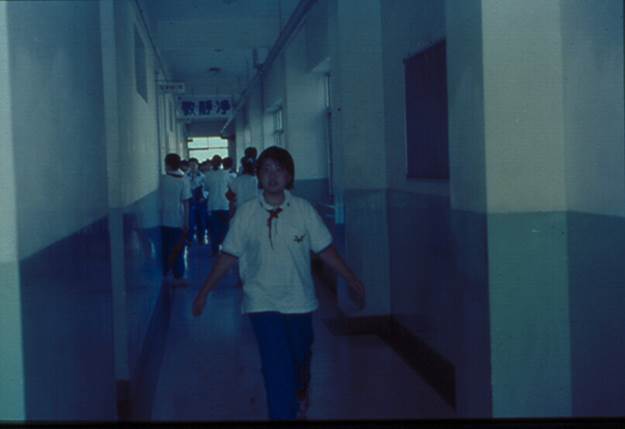

4. Students are allowed 10 minutes between classes. These breaks are often noisy and halls are often crowded with students. How does this compare with your school?
5. Every Monday, schools have a "flag raising ceremony" during which the whole school participates in a morning assembly. Here, a group of students marches and raises the flag of the People's Republic of China. Is there anything similar to this ceremony in your school?
 6. Every morning at around 10 a.m., all students gather to do their morning exercises. Exercises consist of stretching and some calisthenics. Students line up in rows and three or four students lead the whole school in this morning ritual. What do you think of this activity? Is there anything similar to this in your school?
 7. In many Chinese schools, students are responsible for keeping the school clean. The badge on this student's arm indicates that she is on cleaning duty. Who cleans your school? What do you think about the idea of having students in charge of cleaning?
 8. Students also engage in "eye exercises." Students rub specific parts of their face around their eyes and also their necks. These exercises are designed to protect the eyes and are based on the practice of acupressure. Acupressure is a Chinese medical technique in which specific points in the body are pushed or pressed to help relieve pain or treat illnesses. How do you think American students would react if their teachers asked them to do this?
9. Like many places in the world, this Chinese school is concerned with technology and wants students to have access to computers. Students in this middle school can take computer classes and have access to the Internet. There is a huge "digital divide" in China with many schools not having computers. How does this compare with your school?

10. Occasionally, students host a talent show or student assembly. Many students choose to sing, like this student. Some of the songs are in Chinese, but some students choose to sing in English. Are there any events like this in your school?
 11. This shows an entryway to a Daoist temple, a Buddhist temple, the Temple of Confucious in Beijing and a celebration at a Buddhist temple. Look at the colors of the temples and how each one is decorated. How are they similar to places of worship in your country? How are they different?
 12. These are people burning incense sticks and praying at a Daoist temple. Incense can be purchased beforehand and is often used in religious rites, ceremonies, and in prayer. In other religions you know about, do people pray? How do they pray?
 13. The top photograph shows a Buddhist monk. The flags behind him have sutras or Buddhist scriptures written on them. The bottom photo shows a person who is a Daoist priest. (He is the one on the left,) What do religious leaders wear in other religions. Do they have a specific dress code or uniform?
 14. These small Buddha statuettes are displayed in a Daoist temple. Daoism and Buddhism are different religions but share some similar deities or gods. What kind of relationship do you think exists between these two religions, Daoisn and Buddhism? Can you think of other religions that have some of sort of relationship with each other?
