Friday, February 9, 2018

Martin Luther King of the Metaphor

This project is due on Thursday, Feburary 15.  This project is for English classes only.

Students are to take one of the metaphors in Martin Luther King, Jr.'s "I Have a Dream" speech and turn it into a visual metaphor.  We began this assignment in class today.

Artwork should follow these rules:

  1. cover the entire paper with other paper.
  2. use the book page.
  3. include the metaphor in writing.
Here are two samples from other classes.


Here is the video of the speech we watched in class today, just in case you'd like to watch it again.


Monday, January 22, 2018

Ray Bradbury and Technology Paragraphs

Ray Bradbury thinks technology is.....

Write a long paragraph in response to this prompt.  You may use the following outline to complete your paragraph.

Sentence 1 - Hook. Describe one part/moment in one of the stories.

Sentence 2 - Transition to a topic sentence.  "As his story _______ demonstrates,* Ray Bradbury thinks technology is_____________"

Sentences 3 to 6 - Evidence  More points from the story and other stories.

Sentence 7 - Counterpoint or opposing view. "In spite of this,* Bradbury does see some __________ in technology as his story _______________________ illustrates."

Sentences 8 and 9 - Evidence for the counterpoint. Points from this and other stories.

Sentence 10 - Transition to conclusion. "Although, at times Bradbury seems to __________ technology,* his overall view is that technology is ________________"

Sentence 11 - Final words.  Leave the reader with food for thought.  i.e. "We can only hope that he is right/wrong about technology."


* use this or another transition

i.e. - For example

Thursday, January 18, 2018

"The Veldt" by Ray Bradbury

For this assignment use the notes and sketches you made in class today as your rough draft.

Begin by taking one piece of blank paper. You may use any color.


Fold it in half to make a card you can open.


On the front draw a large frame.  Neatly write the title and author: "The Veldt" by Ray Bradbury. Add a picture. You may sketch, draw, paint, or collage any cover design you like. You may make your border fancy.


In side the card draw two frames.


 In one frame create a second piece of art.  Again, you may sketch, paint, collage, etc.  In the other frame write a  $1.00 response to "The Veldt".  Remember, each word is worth one cent.  A, an and the are free.

In your response you may want to answer these things:


  • In the story, what is the future like?
  • What was your reaction to the ending?
  • Who, or what, were the villains in the story?
  • Did everyone "get what they deserved?"
  • What is Ray Bradbury saying about his society?
  • How is this story still relevant, meaningful, to our world today?


Write neatly. Be careful about spelling, capitalization and punctuation.  All of these count. You may type.


For extra credit:

  1. Select one of the other radio dramas from Bradbury Thirteen listed below.
  2. Listen to it.
  3. Draw two frames on the back of your card.
  4. Illustrate the top frame with a picture, the title of the drama and the author.
  5. Write a 75 cent response to it in the bottom frame.  
  6. Earn extra credit in English.


Links to other Bradbury 13 Episodes:


Tuesday, January 9, 2018

China vs. U.S.A. Middle Schools in China and the United States


The pictures below show scenes from middle schools in present day China.  Observe each picture and answer the questions that follow.  Some pictures do not have questions, just text to read.  Write your answers in complete sentences on binder paper.  Each student must write their own answers.  You may work with the people sitting near you.


1. These are three different schools in China. As you can see, they are very different from each other. Which one looks most like the school you attend?
2. This is a student arriving at school. Classes at this school meet from Monday through Friday. What are the students wearing? What are they using to bring their books and papers to school? How are these students different from students in your school?


 3.  This is a list posted outside of a middle school with the names of students who have performed well academically. Is there a similar system to honor certain students at the school you attend?


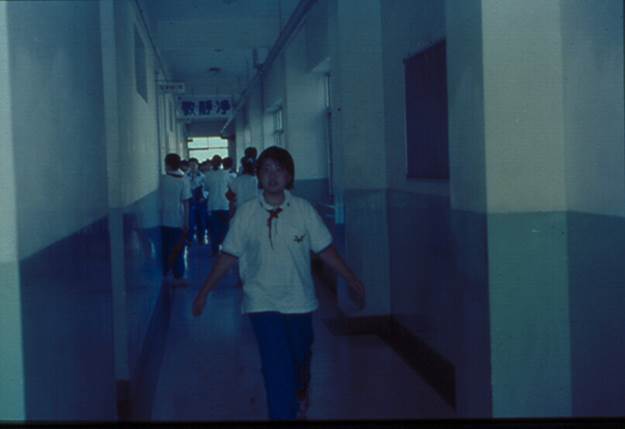
4. Students are allowed 10 minutes between classes. These breaks are often noisy and halls are often crowded with students. How does this compare with your school?


5.  Every Monday, schools have a "flag raising ceremony" during which the whole school participates in a morning assembly.  Here, a group of students marches and raises the flag of the People's Republic of China.  Is there anything similar to this ceremony in your school?


6.  Every morning at around 10 a.m., all students gather to do their morning exercises.  Exercises consist of stretching and some calisthenics. Students line up in rows and three or four students lead the whole school in this morning ritual. What do you think of this activity?  Is there anything similar to this in your school?


7.  In many Chinese schools, students are responsible for keeping the school clean. The badge on this student's arm indicates that she is on cleaning duty. Who cleans your school?  What do you think about the idea of having students in charge of cleaning?


8.  Students also engage in "eye exercises." Students rub specific parts of their face around their eyes and also their necks.  These exercises are designed to protect the eyes and are based on the practice of acupressure.  Acupressure is a Chinese medical technique in which specific points in the body are pushed or pressed to help relieve pain or treat illnesses.  How do you think American students would react if their teachers asked them to do this?


9.  Like many places in the world, this Chinese school is concerned with technology and wants students to have access to computers. Students in this middle school can take computer classes and have access to the Internet.  There is a huge "digital divide" in China with many schools not having computers.  How does this compare with your school?


10.  Occasionally, students host a talent show or student assembly. Many students choose to sing, like this student. Some of the songs are in Chinese, but some students choose to sing in English.  Are there any events like this in your school?


Tuesday, November 7, 2017

History PBL: A Trip to Africa

Your group is a travel agency developing trips to Africa to promote the history of the continent.  Your travel agency is  developing a trip to Africa featuring four historically important cites.  You will present your tour in a sales presentation to a local club, the Rotary Club, to try and convince the club members to purchase your trip.

Your task: Develop a tour package that includes travel to and from Africa from San Francisco, visits and activities at 4 different historical sites in sub-Saharan Africa. Include travel plans and costs (airfare from SFO to first site, travel to and from each site, and hotel costs), as well as an itinerary for your tour. A maximum cost for the trip is $8000.

Your group must choose four destinations for your project.  In your presentation, each member will describe one place in detail.  Group members will also create an individual project about the place they selected.

Select your four destinations from the following list:
  1. The Great Zimbabwe, an iron age city, now in ruins. The area was once the heart of a large trading empire  from the 11th to the 15th century. The city once held nearly 20,000 people.
  2. The rock-hewn churches of Lilibela. These Ethiopian churches were carved into the sides of rocky cliffs during the 12th and 13th centuries.
  3. The city of Timbuktu and it's famous mosques. Visit the current and former capital of Mali where Mansa Musa once ruled.
  4. The two story Somba houses of Koutammakou.  These unusual structures found northern Togo use the first floor as barns and the second as living quarters.  
  5. The mud mosque of Djenne. See the worlds largest mosque constructed entire of mud.
  6. James Island in the Gambia River. Now called Kunteh Kinteh Island, inspired by the television show Roots, this fort was once a major center of trade for gold, ivory and slaves.
  7. Traditional Asante building in Ghana. These 13 structures are the last remaining buildings from the once great Asante Empire.
  8. The tomb of Askia Muhammad in Gao. This mud tomb is said to be constructed of earth Askai brought back from Mekkah after his haj.  Askia once ruled the Songhai Empire.
  9. Goree island in Dakar, Senegal. A place with a dark history. Once a center of the slave trade, the fort on Goree Island was the place where thousands of Africans were kept by slave traders before being taken to America.
  10. The Ksours of Mauritania. These Arabic castles were once major cultural and religious centers along the trans-Sahara trade routes.
  11. Fort Jesus in Kenya. This Portuguese fort in Mombassa was built in 1593 to protect European traders and explorers. It's now one of the most visited cites in Kenya.
  12. The ghost town of Kolmanskop in Namibia. The town was a center of diamond mining for 40 years before it was completely abandoned.
  13. The prison at Robben Island in South Africa. A place with a dark past. This is where Nelson Mandela among many other anti-apartheid activist were held before South Africa became free.
  14. The Beit al-Ajaib, the house of wonders in Zanzibar built for Sultan Barghash in 1883.
  15. The Karen Blixen Museum in Kenya.  Once the home of Danish author Karen Blixen, her house and coffee plantation are now a popular museum.
  16. Lamu Old Town in Kenya. This is the oldest, and best preserved Swahili settlement. The town is on an island without vehicles. Goods and people there are still moved by donkey. 
  17. Le Morne Brabant on the island of Mauritius. This island, now covered with resorts, was once famous as a hide-out for runaway slaves who lived for decades in the islands system of caves. 
  18. Ulundi, the Zulu capital city. Now in the KawZululand region of South Africa, this city was the capital of the Zulu empire and the site of the Zulu army's final battle in the Boer Wars.
  19. The Stone town of Zanzibar.  This town on the island of Zanzibar was once part of the Swahili trading empire.  Now the island is a famous resort destination.
  20. Kilwa Kisiwant.  Part of the Omani/Swahili trade empire founding in the 11th century. This now ruined city was once the heart of a great empire.
  21. Dogan Villages of Mali.  A unique, ancient culture still found in West Africa where people live in towns built into the sides of cliffs
  22. Kimberly Diamond Mine - South Africa. This, the largest diamond mine in the world, is visible from space.
  23. Monrovia, Liberia - This West African city was founded by freed American slaves in the 1830's.
  24. Kingdom of Dahomey. This West African kingdom, located in modern day Benin, was once famous for its women warriors.
If there is another historical site in Sub-Saharan Africa you would like to do, please discuss it with your teacher.

Each group member will be responsible for researching one location in Africa, preparing artifacts based on the group's research and participating in the presentation.

Artifacts:

  • Each group must make a brochure advertising their tour.  This should include historical information for each destination, pictures, itinerary information and a price.
  • Each group must make a keepsake map of Africa showing the destinations on their tour. These should include pictures of each destination and historical information about each.
  • Each group must make two additional souvenirs.  These should be things people going on the tour will want to keep.  They should be visually appealing and contain historical information.  


Presentations..

Your group will give a sales presentation to a local club, like the Rotary Club.  Members of this club are interested in travel and in history.  Your presentation should tell the Rotary Club the details of your trip including the cost.  It should also describe the history of the places you have selected and why they would be an interesting place to visit.  The Rotary Club members do not like listening to a bunch of presentations about the same place, so be sure to pay attention to what the other groups are talking about. You want to say something different from everyone else.

They would like your group to talk for six to eight minutes total.


Schedule

Tues. Nov. 14. Introduction: Trip to anywhere in the world.
Thurs. Nov. 16. Research sites you want to visit.
Mon. Nov. 27. Continue research and notes on sites.
Wed. Nov. 29. Continue research/work on products
Fri. Dec. 1. Complete research/work on products
Tues. Dec. 5. Turn in itinerary with cost. Start work on artifact
Thurs. Dec. 7. Work on artifacts/presentations
Mon. Dec. 11. Work on artifacts/presentations
Wed.  Dec. 13. Presentation run-through. Work on artifacts/presentations
Fri. Dec. 15. Artifacts due by end of day. I mean it!!! Work on presentations
Tues. Dec. 19. Presentation day.

Grading

Each group will get one grade for their presentation including the visuals used, the quality of the information presented and the quality of the groups performance/cooperation.

Each individual member will get an individual grade based on the quality of the artifact.

Each individual member will get a collaboration grade based on how well they work as a group member and how well they meet the assigned deadlines.  There may be regular checks of how much work your group has done each day as part of your grade.

Each of these will be one third of your grade for this project.


Thursday, October 26, 2017

History Test Review: Last Chance to Study!!!

This pictures shows a Medieval feast.  The Lord and his lady sit
in the center.  The man to the left is cutting cheese for them. 
They used only knives, no forks or spoons at dinner. The man
with no shoes to the right is probably a monk, maybe a peasant.
He has interrupted the dinner with a petition and a begging bowl.
He may want money or some other thing the lord has promised
his people.  The young man in blue holding the small sword may
be a squire trying to protect the lord and lady.  The dogs are biting
the man with no shoes, trying to protect their lord and lady. People
in Medieval Europe kept dogs just like we do today. They were 
used for hunting, for protection and kept as pets. Many were allowed
to roam the dining hall, where they could pick up scraps that were
dropped on the floor.
Tonight, start by completing your 4 by 8 study guide. Use the notes in your journal first, then look for information in your book.  Your study guide will be collected before the test tomorrow.

Next, read the chapter summaries for each chapter.  These are short summaries of all the main points in each chapter.  You can find them on these pages: 17, 29, 41, 52, and 59.

Finally, go over the information in your journal one more time.  Make sure your journal is complete, everything in it is glued in, and that your cover looks great.  These are all part of the journal's grade.  Journals will be collected before the test tomorrow.

If you have time, here are a couple of videos you might enjoy.